Austistic-Coded Sitcom Teen-Legend, Daria Morgandorfer, is The Vital Representation All Young Neurodiverse People Need.
Daria was an MTV-hit in the mid 90s that followed the life of 17-year-old high schooler and outcast, Daria, trying to survive in a world she's too smart to be in.

We’ve probably all seen a picture of Daria somewhere. Who? Yes, Daria, the animated deadpan teenage icon who graced the ‘90s MTV landscape. You’ve either seen Daria in the form of a meme, or you’ve scrolled past her during an internet rabbithole session or simply, like me, because you’ve watched her eponymous 90s-fueled TV show. But those who know even the slightest about Daria Morgandorfer realise she’s not another TV cliche. She’s not part of another main-character trope of a young girl who’s ‘kinda weird’ but is a suitable enough pick for a typical high schooler protagonist that many viewers find normal enough that they probably wouldn’t have bullied them if they had gone to high school together. What’s special about Daria is that, perhaps, she says what we’re all thinking. Unlike Daria, we don’t have the guts to say in fear of being disliked.
Only Daria doesn’t care. Because she knows she’s right.
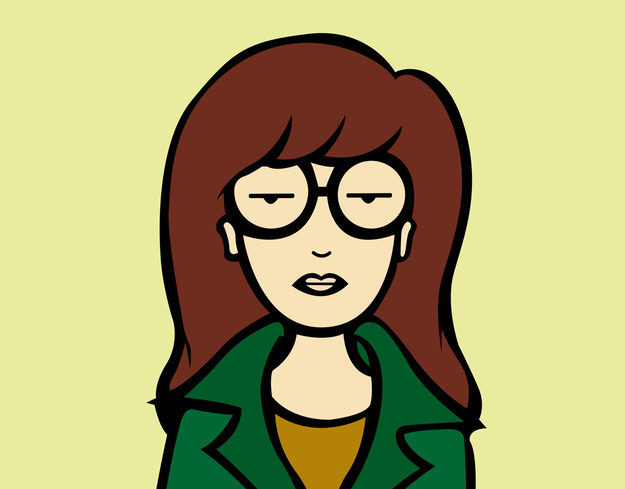
Daria is 17, a brain (a.k.a. her school’s lingo labelling students who are so smart that they’re unpopular) and a lifelong committed nihilist. She’s unimpressed by her peers’ shallowness and inability to reach her wavelength. And, to top it off, Daria is the world’s best participant for a lie-detector test. Because she never lies. Even when she probably should. And to quote the Guardian’s Megan Koester, “Daria Morgendorffer, after all, would boycott her own show, resenting the suggestion she was like anyone but herself” [Koester, 2017].
However, despite her legacy, Daria wasn’t a character born out of thin air and created purely to have her own TV show. In fact, she was created to play the recurring, straight man on another MTV show that many Daria fans won’t last one second watching.
Yes, Daria was created to sort out Beavis and Butthead.
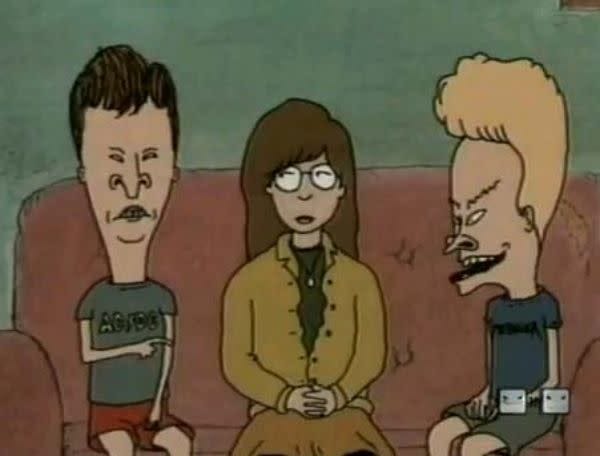
Four years after Daria debuted on Beavis and Butthead as the idotic teenageboys’ classmate at Highland High, Daria landed her own show in 1997.
In her post-straight man career, Daria has moved to Lawndale with her younger, polar-opposite sister, Quinn and their ruthless lawyer-mother, Helen, and neurotic father, Jake. In her main character debut, Daria finally has a chance to charm audiences who may relate to as an outcast who isn’t a caricature of a neurotic nerd or the jocks’ punching bag.
Whilst everyone around Daria is coded as either upbeat, relaxed and indifferent to the world or downright eccentric (namely her dysfunctional teachers), Daria’s trademark of delivering her thoughts, feelings and observations in a flat, monotone voice is what makes the show stand out. Daria’s humour is dry and witty. Viewers will find her hilarious, but her classmates and teachers are baffled by her.
Daria is no stranger to the reality of being an outcast and doesn’t expect her new classmates to perceive her any differently than how she has been treated her whole life: like an alien. But, fortunately for Daria, she makes one new friend at Lawndale High; fellow cynic Jane Lane. With Jane, she can mock the world with and deal with the living, breathing insufferable high school tropes that results in Daria asking her ‘cool’ Aunt Amy if life is always “tawdry, stupid and humiliating, or if it’s just a phase”?
As the show continues to be watched nearly 30 years after its premiere, new audiences are starting to find a deeper meaning behind Daria’s character. Daria’s primary characteristics that make her such an iconic TV heroine have been substantiated by her being the embodiment of teenage angst mixed with jaw-dropping common sense that puts many of the adults around her to shame.
However, as our society constantly progresses and researchers in all areas of life have dedicated their sweat and tears to contribute out-of-this-world discoveries, many viewers have made an intriguing observation. That Daria, whether she was meant to be more or not, is likely autistic.
In the last decade, this has been an ongoing debate amongst dedicated fans on Reddit, niche Neurodiverse forums, that one creative arts university student who took edibles for the first time to ease their anxiety but instead have been plagued with a hyperverbal episode that now everyone at the party have to listen to - you name it. As our understanding of neurodiversity has changed since Daria came to life, viewers of the show have begun to realise the significance of why they might relate to a fictional character like Daria to such a degree.
Daria shows many characteristics of being neurodiverse. However, points arguing that her social skills are too good for her to fall on the autism spectrum have often shut down the conversation. This, and people being sick of others ‘overmedicalizing’ everything… apparently.
Throughout the series, Daria’s neurodiversity becomes more and more visible. The most obvious factor being that she doesn’t like socialising, is depicted from the get-go. She’s brutally honest, she takes many things literally, she speaks in a monotone/flat tone and shows little or no emotion for 99.99% of her existence. Her vocabulary is like one of ‘a walking dictionary’ and she prefers to read rather than talk to people (not that this is a clinical symptom but…if you think about it…).
Daria is different, and she’s very well aware of it. She is ostracised by others, including her own sister, Quinn, who starts a running gag of refusing to acknowledge Daria as her sibling due to being embarrassed by her. Her friends, whether they see Daria when Quinn invites them over or passing her at school, Quinn’s friends from the “Fashion Club “ ask her if Daria is her cousin, a foreign exchange student or “the girl that’s just always at your house, or, whatever”.
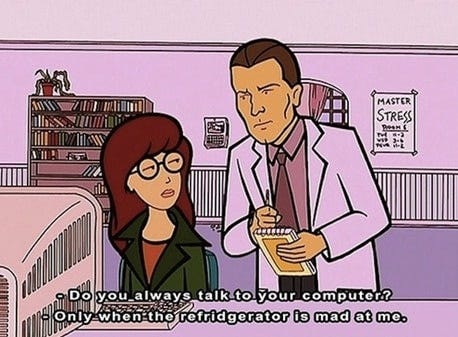
No one ever refers to Daria as autistic on the show, but flashbacks to Daria’s early childhood in the last few episodes of the show demonstrate the genuine struggles Daria had in her formative years. Her social struggles are identified by her teachers and parents, who take her to psychologists to rule out any problems. This period of Daria’s life, whilst quite blurry in her memory, is one that she remembers fuelling conflict between her parents as they argued about how to raise the unique child that they had.
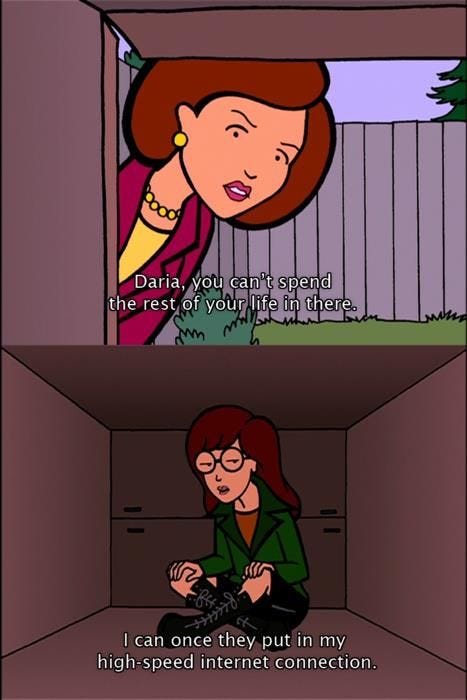
In the series finale, a massive box appears in Daria’s backyard from a new fridge delivery that her mother asks her to dispose of. But as she faces the boxes, these memories come back to her as she remembers having a box as a child, which she would escape to when the world became too much. When Daria’s parents confirm that her memories of them fighting about her when she was younger are true, she, like she did as a child, crawls into the box in the backyard and refuses to come out. Whilst Daria is not as emotive as you and I may be, her standoff in the box demonstrates that Daria does get overwhelmed. She gets so overwhelmed that her only way of coping is to climb into the box and go into shutdown mode.
You may be wondering why giving a non-professional diagnosis to a cartoon character whose TV show ended 23 years ago even matters. Perhaps because Daria is still a show people watch, thanks to the power of streaming platforms. In the UK, Daria’s wide availability on multiple streaming platforms showcases its impressive ability to remain relevant for a new generation of viewers.
For years before I watched the show, Daria’s face became recognisable to me. From meme pages to screencaps posted on social media capturing a hilarious scene, many came to know Daria without even knowing her origin. So when that very character pops up on your Prime Video suggested feed, it can be intriguing to see if the show lives up to the one funny quote you saw somewhere, god knows how long ago.
With Daria’s appeal still being attractive to today’s young people, a new generation watching the show means our values are slightly different, and our understanding of the world has shifted. Whilst Daria served as the weird, misunderstood girl in the 90s that could’ve been you or a peer you had taken for granted, Daria can now serve as a figure of excellent, realistic autism representation on TV.
When I first watched Daria 18 months ago, I heavily resonated with Daria and found her very easy to love. I was a diagnosed ADHDer who had been wondering for the last few years if I was autistic myself, but had kept my thoughts a secret in fear of being accused of being another Zoomer trying to jump on the bandwagon of labelling myself autistic to make sense of why I felt like an alien amongst my university cohort.
Seeing a character like Daria on screen left me feeling warm and going so far as to why I felt like in a sense, that Daria was representing people like me. People like me, as in weird (my therapist says I’m not allowed to call myself this anymore), bad at lying or a chronic Doc Martin’s boot wearer? Could there be something else to make me want to idolise a cartoon character? Yep, there must be someone else who is thinking what I’m thinking.
I googled my question regarding Daria’s potential neurodiversity status at that time, seeing what others thought. Many agreed with the stance, with one person thinking Daria had ADHD because of her social skills and default impulse to respond sarcastically to everything. Whilst it was a suggestion, Daria does not align with ADHD characteristics.
Like many women in real life, even Daria, the fictional teenager from the mid-90s, was slipping through the cracks of a somewhat autism confirmation based on ideas that some Reddit users had. However, in real life, it’s not the Reddit women and more-masking types of individuals to slip through the cracks; it’s medical professionals. Even cartoon characters can’t escape being dismissed because they only fit 4 out of 5 on the checklist of an extremely complex, multi-layered conversation.
I decided to rewatch Daria last month after a doctor’s opinion flipped my life upside down. She suggested that there was a likelihood that I was on the autism spectrum and encouraged me to go forward with further testing.
For many late-diagnosed autistics, a diagnosis can be a blessing. It’s a sense of validation of why one may be the way they are. That there isn’t anything ‘wrong’ with them. Knowing this about themselves can create a much better understanding of why they do the things they do and their perception of the world compared to their neurotypical s’ lens.
Daria will never have a diagnosis. She doesn’t necessarily need one, because she’s not real. But being a representative of female autism is likely something the creators behind her show never pictured for her. Over the years, she’s become a representation for girls who are different, weird and underappreciated for the unique qualities in their youth, specifically in their teenage years. Daria is still the face of this.
But watching Daria now with the idea of seeing an individual on screen who many autistics, like myself (although not with an official diagnosis yet), can relate to, is phenomenal. Representation may not seem like a big deal for many people who, perhaps, are lucky enough to see people in the media who look exactly like them and don’t feel like the journey to validating their authentic self was a challenge. But for people who have struggled to fit in their entire lives, whatever the rooted reason is, it can mean the world.
At the start of my journey, accepting a potential autism diagnosis means bringing Daria along with me. After a quarter of a century spent being the answer to weird-girl representation, Daria’s new purpose is more electrifying than you may believe.
I know I’m not Daria. If anything, I can sometimes be Daria’s foil when too excited or deep into masking at a dinner party so I don’t seem rude. But characters like Daria are there for me at my vulnerable moments and to remind me that I’m not an alien.
Daria is one of many great characters that substantiate why representation on screen is so important. Whether it’s telling minority ethnic groups’ stories or pushing for authenticity by hiring disabled actors to play disabled characters, it’s not only liberating to give underrepresented groups a platform, but it also makes individuals feel less alone. It’s a joy to be able to hear people’s stories and be able to relate to someone in such a specific context, regardless of whether they’re fictional or not. Behind these characters are performers, writers and other creatives who collaborate on ideas and experiences of their own. And these people are very much real.
And for that reason, Daria makes me less alone. Whether that was her purpose or not, who would’ve predicted twenty years ago that a cartoon character could do so much good without even having to try?